- A part dips below its minimum and the request makes itself, branch by branch.
- Brand and distributor prices sit on the supplier, not in a notebook.
- Parts already on order count, so no branch orders them twice.
Low stock reorders itself
Dealer management system · India
Parts bought and binned, the job card, parts issued to the job, the invoice and the warranty claim on one ERPNext record, at every branch.
Free 30-minute call · No sign-up, no card, no account for the demos
Fixcent: service, parts and warranty in one ledger, live in 9 weeks per region; service to invoice the same day. Read the case
A job, from the parts shelf to the warranty claim. Tap a step to see it running.
A job, travelling the workshop.
Low stock reorders itself
The lead flow. Pick a station above for its own.
Running today
What each one ran before, what changed, and what came of it. Every figure is from the case itself.
Delivered 2026.
Pick a step: what changes, then watch it run on a demo company.
Low stock reorders itself
Goods arrive and get checked
Count the shelves without closing
Where the demo stops: Bins and serials are standard; the vehicle-fitment table is configured for your range and isn't in the live demo.
Where the demo stops: Service bookings are configured for your workshop; they aren't in the live demo yet.
A complaint, owned and closed
Where the demo stops: Our demo shows a complaint owned and closed; the job card runs in a field-service app beside ERPNext, as Fixcent's does.
Where the demo stops: Issuing parts against a job is configured on your system; it isn't in the live demo yet.
A complaint, owned and closed
An unpaid invoice gets collected
On our automotive demo company: a warranty claim to the manufacturer with the part, the labour and its status.
Open the automotive demoWhere the demo stops: Settling the claim in the books is configured on your system.
A contract that bills itself
The owner's morning check
Mith Demo Motors is a car dealership: showroom stock, bookings, loans, delivery and registration. Its own records on the real screens; you sign in as a visitor and look around.
Three-hour visitor sign-in · nothing emailed · resets nightly · made-up records
We work with the system you have. Pick it and see the first step.
What do you run today?
Keep Tally for the books while parts, jobs and warranty move across; the tie-out is checked both ways.
Parts, opening stock by branch and party balances come across; bins and fitment are set up first.
Books stay or move, your call; parts, jobs and warranty come into one system either way.
You can stay on B1 and we support it, or move; the workshop side runs on one ledger either way.
If your OEM mandates its dealer system, it stays; we run parts, jobs and books beside it and connect them.
We read what it holds — vehicles, jobs, parts — and move what you need; what it does well, we say so.
A declutter audit first: what was over-built, what is unused, what to fix in which order.
The job sheets are the real system: they become job cards with their data imported, beside the books.
Fixcent ran exactly this; one record replaced them, region by region. We draw that before anyone quotes.
The store's orders arrive as orders and draw the same parts stock the workshop uses.
Build first, pay if you like it: we set up one branch's parts and job cards, and you watch it and its cost.
Build first, pay if you like it: one branch, its parts and its jobs, live before you commit.
Build first, pay if you like it: parts, jobs and the books on one record from the first job.
Five questions and you'll see what fits, with the flow that proves it. The demo is free.
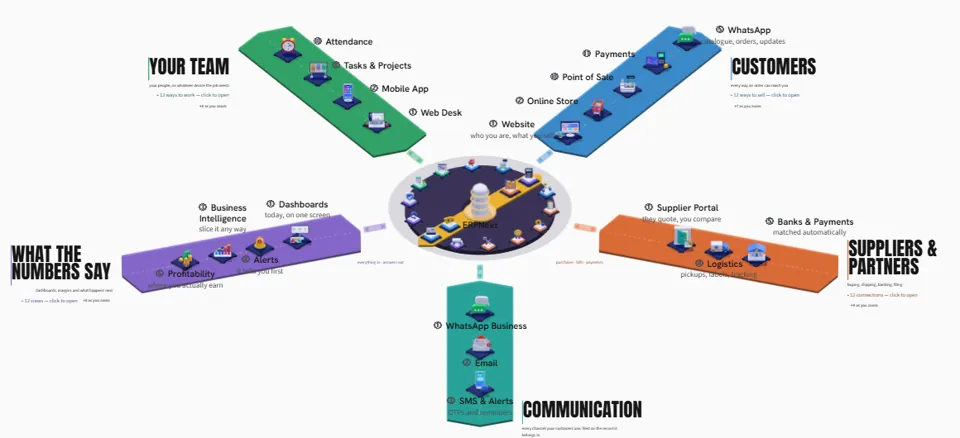
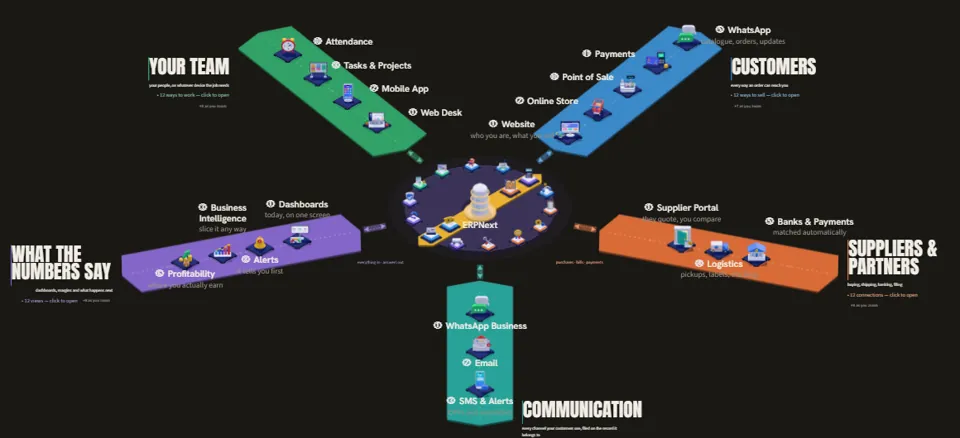
Parts, the job card, warranty and invoices post to one ledger at every branch. A reference picture: the map shows what plugs into the workshop.
See what changes for automotiveIn the workshop
Getting started
One message, call or WhatsApp is enough. Every line reaches the team directly.