- Stock dips below its minimum and the request makes itself, godown by godown.
- Suppliers quote in their own portal, and you order from the quote you picked.
- What is on order already counts, so nobody orders it twice.
Low stock reorders itself
Distribution ERP · India
Buying, godowns, dealer orders and collections on one ERPNext system — with the orders your credit rules shouldn't let through, stopped.
Free 30-minute call · No sign-up, no card, no account for the demos
Splendx: four warehouses on one stock figure, live in twelve weeks. Read the case
Your chain, station by station. Tap the one that leaks to see it running.
An order, travelling your chain.
A dealer orders on their own
The lead flow. Pick a station above for its own.
Running today
What each one ran before, what changed, and what came of it. Every figure is from the case itself.
Delivered 2026.
Module count read from the codebase.
Tick what your business actually does. You get three lists: what runs as it comes, what we configure, and what still needs an app beside it.
Your setup: 2–4 godown(s) · 50–250 parties · more than one godown · customer-wise rate lists · credit limits and overdue blocking
Pick a step: what changes, then watch it run on a demo company.
Low stock reorders itself
Goods arrive and get checked
A bad delivery goes back
Stock moves to another branch
Count the shelves without closing
A dealer orders on their own
An order taken in the customer's shop
Selling abroad, in their currency
Where the demo stops: A rep's beat plan and journey tracking are not in the live demo yet — today we run the ordering, and say plainly where a field app earns its place.
A dealer orders on their own
An unpaid invoice gets collected
Where the demo stops: The demo parties carry no credit limit, so the live demo shows the order, not the block — we set the limits with you at go-live.
An online order, start to finish
Today's delivery, tracked
A return, handled cleanly
Where the demo stops: Freight tracking across carriers is its own job, on the logistics page.
An unpaid invoice gets collected
The bank statement matches itself
The owner's morning check
Where the demo stops: Scheme and claim reconciliation, and capturing what stockists sold, are configuration work on your own rules — they are not in the live demo yet.
We work with the system you have. Pick it and see the first step.
What do you run today?
Keep Tally for the books while godown stock, party rates and credit move across; the tie-out is checked both ways.
Masters, opening stock and party balances come across; the godown structure is designed first.
Books stay or move, your call; stock, orders and credit come into one system either way.
You can stay on B1 and we support it, or move; either way the dealer and godown side runs on one ledger.
We read what you have and give a second opinion before anyone proposes a move. We don't implement those suites.
What it does well we keep; the rest becomes forms and reports in one system, with its data moved.
A declutter audit first: what was over-built, what is unused, what to fix in which order.
The trackers are the real system: they become forms with their data imported, beside the books you keep.
One of them becomes the record; the others feed it or go. We draw that before anyone quotes.
The storefront's orders arrive as orders; stock and dues answer in one place.
Build first, pay if you like it: we build one real flow of yours, and you watch it and its cost.
Build first, pay if you like it: one godown, one party set, one flow, live before you commit.
Build first, pay if you like it: the buying and selling flow on one record from day one.
Five questions and you'll see what fits, with the flow that proves it. The call is free.
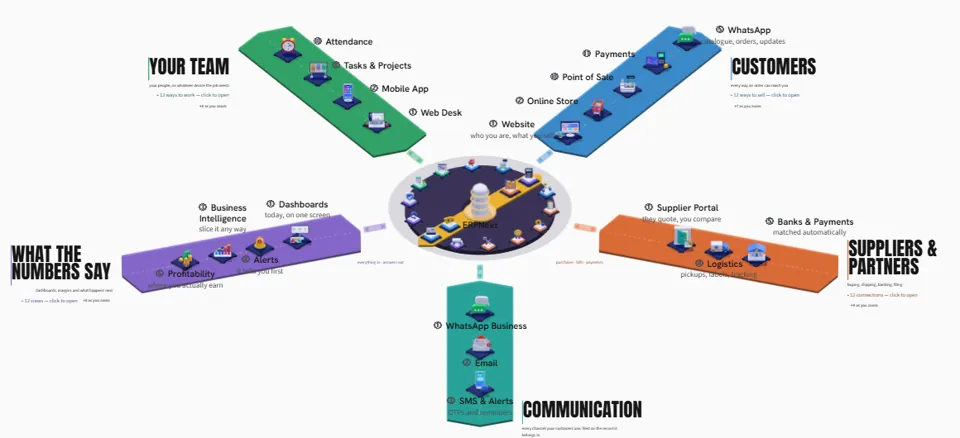
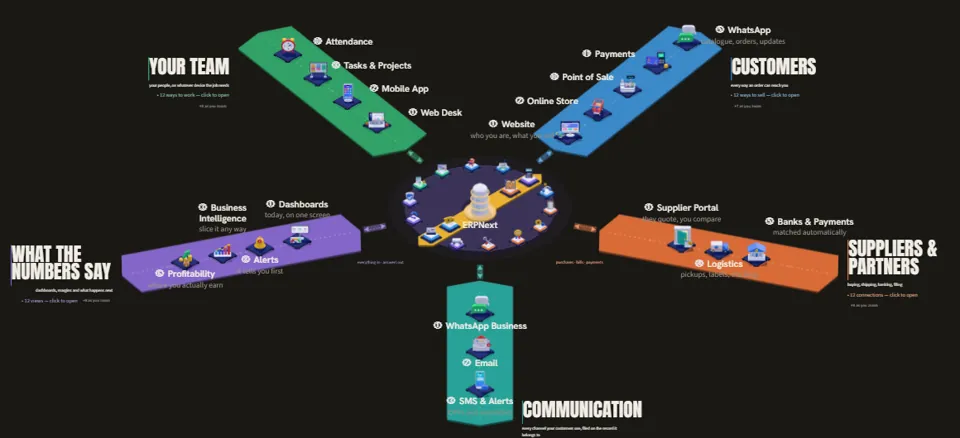
Godowns, dealer orders and collections draw one stock figure. A reference picture: the map shows what each branch and dealer connects to.
See what changes for distributionStock and credit
Schemes and the field
Getting started
One message, call or WhatsApp is enough. Every line reaches the team directly.