Garment & textile ERP · India

One style, every size, every shade.Garment and textile ERP in India

Styles, fabric by lot, the CMT unit, finishing and export on one system — with what went out and what came back counted against each other.

Free 30-minute call · No sign-up, no card, no account for the demos

Risitex, a clothing manufacturer: dealer, bulk and retail prices on one platform, three channels on one ledger. Read the case

Where does it go missing?

Your chain, station by station. Tap the one that goes missing to see it running.

One style, travelling your chain.

Example style · 6 colours × 7 sizes

  1. 42 SKUs, one BOM
  2. Fabric by roll, shade, lot
  3. Cut from one lot
  4. Out to the unit, back counted
  5. Checked before packing
  6. In the buyer's pack
  7. Billed in their currency
  8. Three channels, one ledger

Work sent out and back · 4 screens · You end with the pieces back in stock at material plus the unit's cost

Running today

Apparel and textile we run today.

What each one ran before, what changed, and what came of it. Every figure is from the case itself.

Risitex (Lamongie)
BeforeSeparate dealer and retail pricing
What changedMedusa.js 2.0 + ERPNext
Built and run~30custom modules · 3 channels: export, bulk, retail
Splendx
BeforeEmail orders, WooCommerce
What changedMedusa B2B + ERPNext
Live in12 wksto go-live · 4 warehouses on one stock figure

These are the two closest to a garment unit we can name today. When an export house is on the list, it will be here with its own numbers.

Every case study

Describe one style. See what it takes.

Your style, through the chain

Describe one style. You get what it becomes in the system, what leaves for the unit, what should come back, and what we'd set up for you.

An example to start: the forty-two SKUs from the pain above. Change it to yours.

Your style becomes

42 SKUs

6 colours × 7 sizes = 42 SKUs from one style — one item with two attributes, size and colour, not 42 codes typed by hand, and one bill of materials that sizes itself per variant.

6 colours down, 7 sizes across

What leaves for the unit

A subcontracting order for the work, and the material it needs: fabric by the lot it was cut from, the cut parts, and your trims.

What should come back

The order's 500–2,000 pieces, counted against what went out. A shortage shows as the difference between what was issued and what was consumed, not as a phone call — and the finished piece carries the material plus the unit's cost.

What we'd configure

  • The per-piece rate by style and operation
  • Your shortage tolerance
  • Your challan format
  • Your size set and colour list as attribute lists, reused across styles
  • Buyer-wise packing

Not in the live demo yet

  • The cut plan and marker wastage
  • Buyer packing formats and shipping marks
  • The export documents
See work sent out and back

Every number here is your own arithmetic. Free 30‑minute call; no sign-up for the demo.

Station by station, what changes.

Pick a step: what changes, then watch it run on a demo company.

What changes · Style and BOM
  1. One style is one item with two attributes, so its sizes and colours exist without typing a code for each.
  2. One bill of materials sizes itself per variant: fabric by consumption, trims by the piece.
  3. What a piece should cost is known before the first bundle is cut.
See it run

Made to order
4 screens · you end with the finished pieces in stock, costed

Our playbooks Affordable Open-Source ERP for Garment & Textile ManufacturersMulti-Level BOM in ERPNext (2026): Setup + Costs

All 24 manufacturing playbooksOpen-source ERP for garment and textile manufacturersEvery live demo

Start from what you run today.

We work with the system you have. Pick it and see the first step.

What do you run today?

Keep Tally for the books while styles, fabric, job work and dispatch move across.

Garment orders and job work on one record.

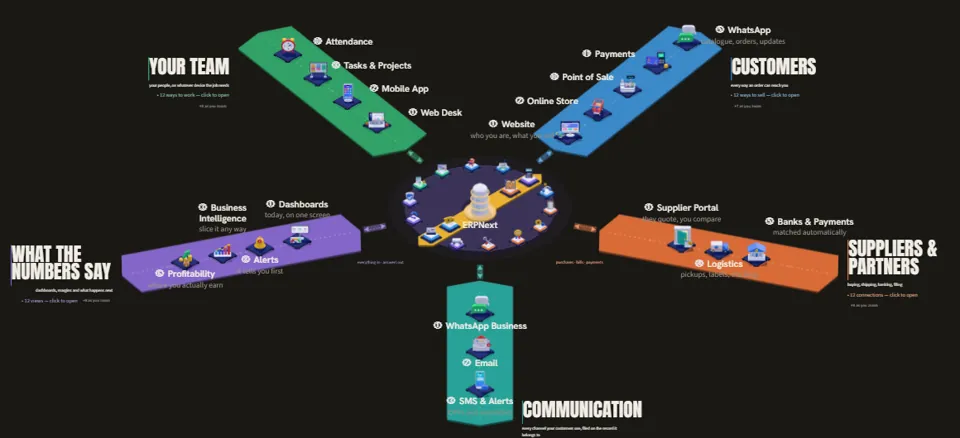
Orders, job work and dispatch post to one ERPNext record, and the dealers draw the same stock. A reference picture: the map shows what plugs in.

See what changes for manufacturing

Questions garment makers ask us.

Will one style with forty-two SKUs drown the system?

No. A style is one item with two attributes, size and colour, so its variants exist without a code typed for each, and one bill of materials sizes itself per variant. Stock, orders and costing all report by style or by variant, whichever you are looking at. Adding a colour next season adds a variant, not a new style.

Fabric and job work

Cost and dispatch

Getting started

Start with one conversation

One message, call or WhatsApp is enough. Every line reaches the team directly.

Team away now